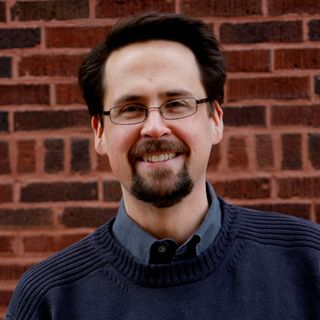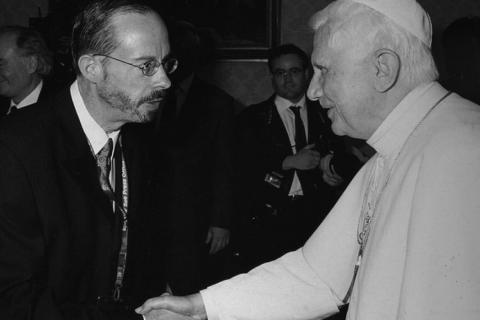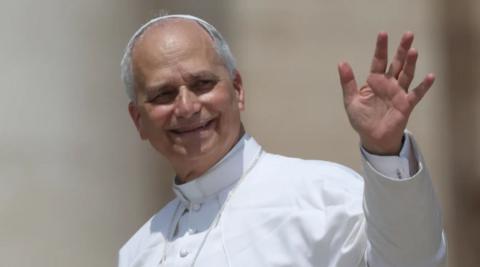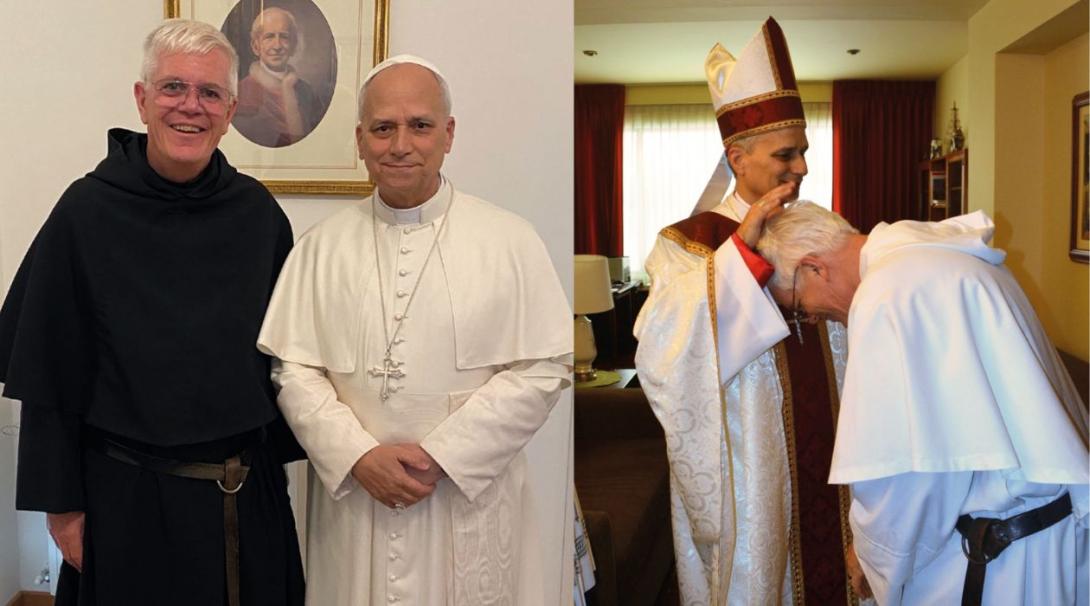
Father John Lydon with Pope Leo XIV. Photo courtesy of Father John Lydon, OSA.
We wanted to speak with the Augustinian friar who worked alongside Fr. Prevost (Pope Leo XIV) in Peru.
Father John, thanks for talking with us about your time in Peru. You really made the round of media interviews back in early May, when your friend was raised to the Chair of Saint Peter. I want to ask you some of the same old questions—I hope you don’t mind! But first, tell me, where were you when you heard the news?
Since January, I have been assigned to the Augustinian seminary in Chicago, and therefore I was in our house there when I saw the white smoke and heard the name “Robert Francis” proclaimed. Since I knew his middle name, which many would not have been aware of, I knew right away, before they got to his final last name, that it was my friend and colleague in Perú who had been elected pope.
Which seminary is this, where you are now resident, and where you work?
It is called St. Augustine’s Friary. It is actually a formation house (although most people don’t understand that terminology and call it a seminary). This is where the young men from the United States and Canada come for their theology training. Their classes are actually held across the street at Catholic Theological Union (CTU), and their Augustinian formation is done in our residence. Fr. Bob would have studied at CTU his theology, from 1978–80, although the house where he resided was different than the present house. He lived at the present house as formation director for just a year when he finished his service as Prior General of the Augustinians.
Did you realize on that day in May that the media might be calling for a comment?
One news media outlet had contacted me several days before the beginning of the conclave to set up an interview in what they said was a longshot possibility that an American would be elected pope. So just an hour after the election, I was on national television being interviewed and other news outlets saw that and then for the next several days I was bombarded for interviews by different news outlets from different countries.
Do you remember what you said in that first interview? I mean—you must have been shocked. Right?
The first interview was with CNN and focused on my time with him in Peru. They wanted to get a perspective from different people who had actually lived and worked with him. I was, like most of the world, very surprised by his election, simply because the conventual wisdom was that an American would not be elected. I had thought that he would not be considered so much as an “American” than as a “missionary,” and thus felt that if any American could be elected it would be him.
I find that many people have a general idea of who the Jesuits are, who the Franciscans are, maybe who Benedictines and Carmelites are; but they don’t seem to know who Augustinians are, and what gifts they uniquely bring to the life of the Church
Going back to your time in Peru, where you lived in the same house with Pope Leo, tell us something about your work there. What were you doing? What was he doing?
I lived with the Pope in Trujillo, Peru from 1990 to 1999. We were primarily involved in the formation of Peruvian Augustinians. In 1988, Pope Leo had been sent to Trujillo to open our formation house there. I joined him two years later in that same community. So, we lived together, prayed together, worked together, and ate together during all those years. Our principal focus was the formation of Peruvian Augustinians, which also involved us attending to two parishes in that area of Trujillo and in teaching at the Seminary.
Will you tell us something about the Augustinian charism, specifically, and how we can see it at work in Pope Leo now?
The Augustinian charism is based on the Rule of St. Augustine, which talks of community life as a way of having “one mind and one heart oriented towards God.” It is this ideal of building local communities of “one mind and one heart” that we see as the fundamental Augustinian charism. This is not just in our local Augustinian community, although it is necessary there, but also in the ministries where we serve. Thus, building communities in the diversity of its members is at the heart of the Augustinian ideal. I suspect that this will be an important part of the perspective he brings to the papacy, namely, working in a divided world for unity in diversity, for dialogue with different opinions, perspectives, and religious beliefs, for the building of bridges between people of diverse perspectives rather than walls.
Have you been to Rome since the election?
I was recently in Rome—the first week of October—to attend a conference organized a year and a half ago by Villanova University on the theme of migrants in our common home. While stationed at Villanova, when I returned from Peru in 2023, I was on the steering committee for that conference and thus I attended it. The conference was planned long before Pope Leo was elected, but it provided me the opportunity to also have a private meeting with him. I also was able to have lunch with him and the Augustinian community that works in the papal sacristy.
What is it like to talk with your friend now that his office has so dramatically changed?
The Pope is a very down-to-earth person so it’s always easy to talk with him. We were able to talk about many things, especially our common time together in Peru. Obviously, what is new is that one shows a sign of respect towards him as being the head of the Catholic Church.
I find that many people have a general idea of who the Jesuits are, who the Franciscans are, maybe who Benedictines and Carmelites are; but they don’t seem to know who Augustinians are, and what gifts they uniquely bring to the life of the Church…
As I mentioned, the central aspect of our charism is the building of community life. This takes place in our local communities, our local apostolates, and in the world at large. Thus, St. Augustine talks in his Rule of Life about sharing resources, with everything in common; he talks about the need for forgiveness with those who offend us; he talks about sharing prayer, meals, and life together so that no one suffers want because all share as brothers and/or sisters. This leads to a concern for the poorest member of society—for seeing all of the resources as being created for the good of all, and not just a few; for the promotion of human dignity as a fundamental concept based on the belief that each person is made in the image and likeness of God. I believe these will be fundamental concepts in the Pope’s teachings.