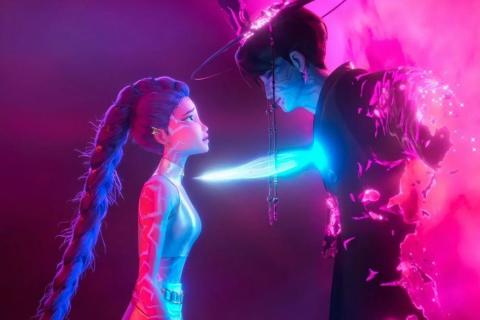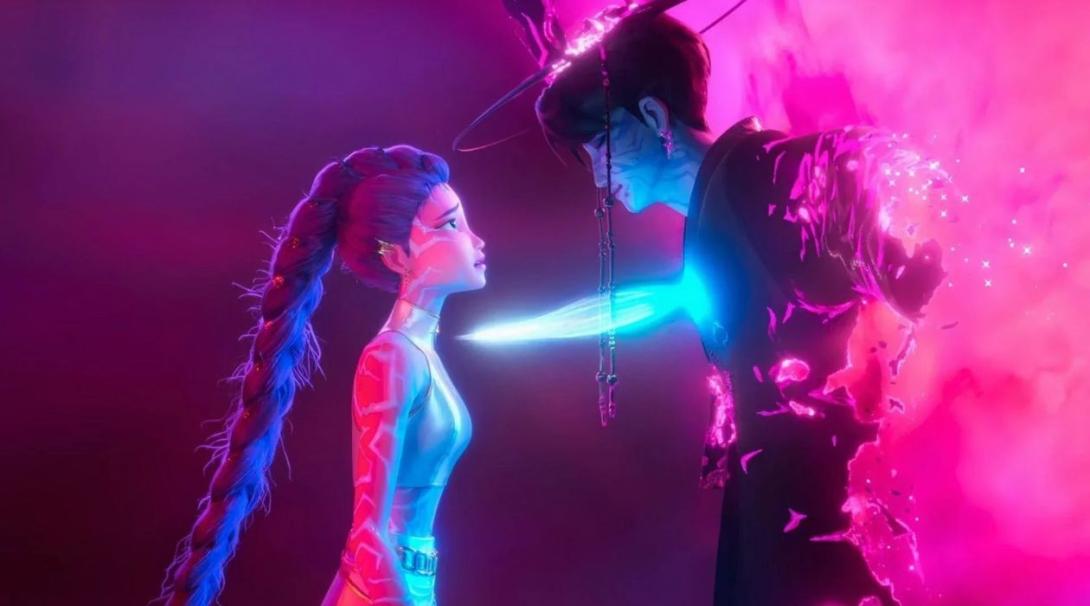
A still from the movie KPop Demon Hunters
Home alone during a weekend of snow and ice, I stepped into the world of KPop Demon Hunters (Sony Pictures Animation, 2025; Running time 95 minutes; Distributed by Netflix) and have carried the warmth of its message ever since.
I think the best movies and books for young people are not only beautiful and uplifting, but also help them and the adults that accompany them to ask deep questions about the world. KPop Demon Hunters has this in spades.
At the start, all indications point to a fun and action-packed sing-along with a strong “wounded healer” plot line. The “Huntrix,” a Korean pop band made up of three girls, Rumi, Zoey, and Mira, is primed to save the universe from evil demons. By sticking together, growing in their friendship, and spreading the message of light and security that emerges from positive relationships, they are set to deliver a nice message for our world.
But then there’s more. The first indication that this movie would offer something deeper comes when the “Saja Boys” demon band sing their song, “Soda Pop.” Admitting that their look was attractive and their beat “infectious,” the Huntrix girls nevertheless sense something is off. They detect the presence of demons, evident by flashes of “patterns” on their skin. Could there actually be a very dark side to the ways in which popular culture depicts people as commodities and the consequent transactional nature of their relationships? As the lyrics to “Soda Pop” tempt: “I need you to need me, I’m empty, you feed me, so refreshing.”
I suddenly had a flashback. Years ago, as an adult accompanying high schoolers to a community event, I was on a bus seated next to a girl who asked me to listen to her favorite Back Street Boys song, which croons: “I don’t care who you are, where you’re from, what you did, as long as you love me?” I felt there was enough conversational trust to gently prod: “Are you really sure you want to date someone who won’t make an effort to understand your background, and who you are?”
I don’t know if that question stuck, but I sense now that the KPop Demon Hunters peer-to-peer observations might be a more effective invitation to help young people develop a critical perspective on popular culture. Throughout the film, the trope of keeping one’s eyes peeled for demonic markings cleverly invites the viewer to stay on the alert for what might be lurking beneath the seemingly attractive music. And by movie’s end, I believe that many who watch will be keyed into the important question of what will ultimately hurt rather than help.
This is the theological insight so needed in our culture: the capacity to distinguish between the presence and distortions of what is evil, and those who have done something wrong, even gravely wrong.
What should be our posture when we detect patterns of what can be named as evil? Here’s where KPop Demon Hunters gets cosmically deep. The song “Takedown” is a battle cry to destroy the non-human demonic creatures who sometimes wear a human disguise: “Cause I see your real face, and it’s ugly as sin / Time to put you in your place, cause you’re rotten within.” Violent destruction is the only course of action: “A demon with no feelings don’t deserve to live, it’s so obvious.”
But what happens when we touch the human story that has led someone to do something wrong, or as this movie is not shy to explicitly name—to sin? How do we interact with people who can still express sincere remorse, the desire to change, and reach for what it might mean to be truly free? And how about when we experience the fragility that emerges from ambiguity or wrongdoing in our family systems or communities, and these take the shape of forces and patterns that I may not even fully understand? In both scenarios, one’s real face, and what should be the consequences of wrongdoing, seem much less obvious.
Even deeper, what happens when one has the insight to name and admit not only the wrong, but the distortion that it has worked in one’s life? For a taste of the beauty of an honest dialogue that transpires in the song “Free,” listen to this: “Between imposter and this monster, I have been lost inside my head.” “We can’t fix it if we never face it.”
I was left with a sense of Wow. This is the theological insight so needed in our culture: the capacity to distinguish between the presence and distortions of what is evil, and those who have done something wrong, even gravely wrong. People are not demons, no matter what they’ve done. And it may be precisely through loving recognition of their human face that they might find the insight, courage, and strength to open themselves to healing and to change.
A great work of art often stirs up a memory of an encounter with other great works of art. As I took in the message of KPop Demon Hunters, I mulled over an earlier experience of reading my favorite C.S. Lewis novel, a retelling of the Psyche myth, Till We Have Faces (1956). And I remembered the immortal line from Leonard Cohen’s Anthem (1992): “There is a crack in everything / That’s how the light gets in.” All of these works of art invite a cosmic awareness of human limits—including human sinfulness—and the hope and healing that emerges when one learns to stop hiding from the truth of those limits.
The beauty of the journey of these demon hunters into “seeing all the beauty in the broken glass” is how the movie emphasizes the power of community in the healing process. The great damage of listening to demons and demonic forces is that they can “get between us,” break down trust, and stoke division. But extraordinary healing power emerges from the realization that “none of us are out here on our own.” “Dive in the fire and I’ll be right here by your side.”
You may have overlooked, or quickly dismissed, the value of this movie on first glance. I urge you to take a deeper look at what it has to say for all of us.