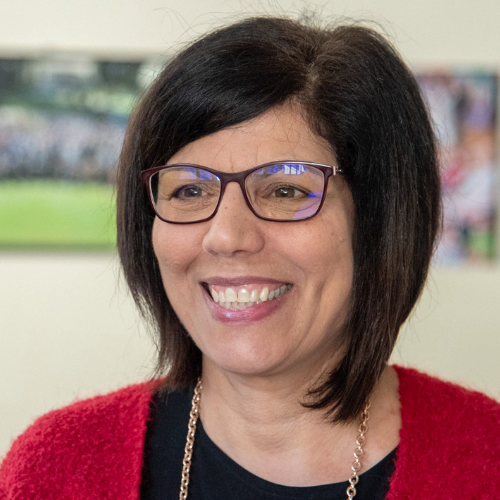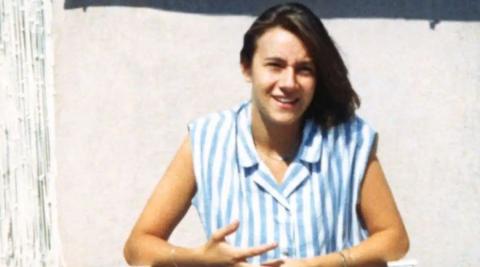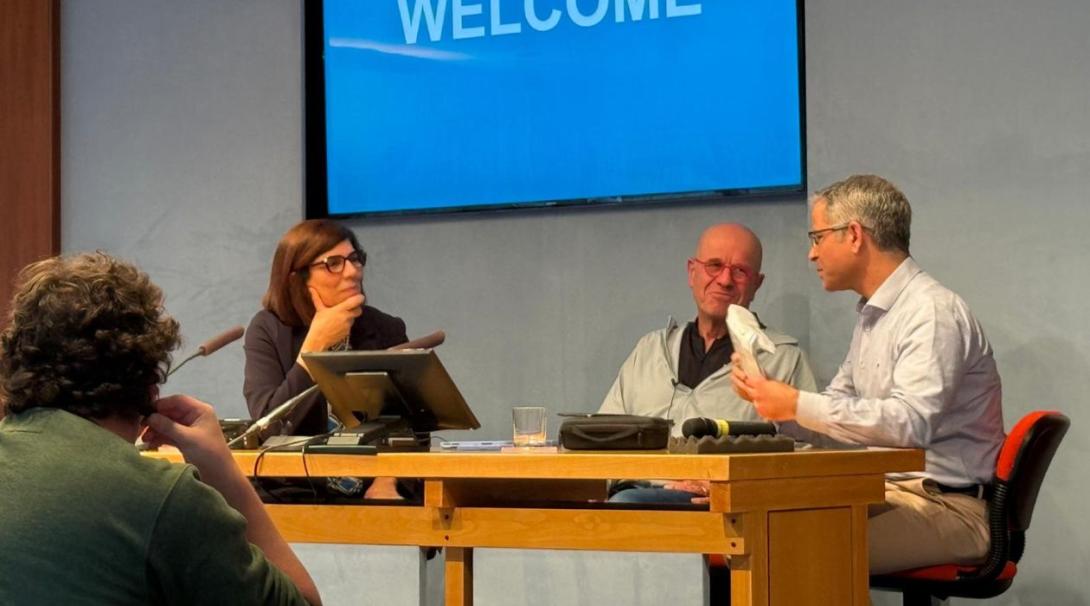
Margaret Karram being interviewed by Avrum Brug. Photo by courtesy of Jerusalem Talks
This is an edited version of an interview with Margaret Karram, President of the Focolare Movement, and Avrum Burg, former acting president of the State of Israel, originally recorded for the Jerusalem Talks podcast produced by Notre Dame Jerusalem. Portions of the conversation have been selected and edited for clarity. We have also used short headings to identify specific topics. You can listen to the full interview here.
Childhood in Haifa
Avrum Burg: Margaret, you were born in Haifa. A friend once told me about Haifa that it is maybe the most significant city in Middle East. Because it’s a city neither Moses nor Jesus nor Muhammad ever set a foot on. So, therefore, it functions. Tell me about the Haifa of your childhood.
Margaret Karram: It is a city in the north of Israel, in the region of Galilee. And my family is an Arab Catholic family, originally Palestinians. I have two sisters and one brother, and our home was at that time in a Jewish neighborhood. So all of our neighbors were Jewish, and I went to a school run by Catholic nuns.
In the school all the students were Arabs. They were Catholics, Christians from different denominations, and Muslims. So I grew up in a multi-religious and multicultural atmosphere. And when I went back home, I was surrounded by Jewish boys and girls.
When I was fourteen years old, some young people came to our school and they talked about the Focolare Movement. I had never heard about it. It was very new in our country. I was not really interested because I was already practicing my Christianity, and my parents really educated us as Catholics. We were going to church every Sunday. I considered myself being a good Christian, so I didn’t need anything else. But when I heard these young people … they were so enthusiastic about what they were talking about. And I saw in their faces a lot of joy.
How did I solve this problem? I decided, first of all, that I am Christian, and I belong to that people. I belong to God.
A Complex Identity
Avrum Burg: You referred to yourself as a Catholic Palestinian. Actually, you have three IDs. You have an official Israeli ID?
Margaret Karram: Yes.
Avrum Burg: Which is in conflict with your national Palestinian identity. And then you are a Christian?
Margaret Karram: Yes.
Avrum Burg: Take us through this maze. How is this clash of identities working? Who are you? When I stop you at the roadblock and I say, “Margaret, give me your ID,” which one do you give me?
Margaret Karram: Well, I was born when there was the State of Israel, after 1948. And my parents got also Israeli citizenship because they stayed in the land. Other family members like my grandma and grandpa, uncles and cousins, flew to Lebanon and they hoped to come back. We were the only part of the family from my dad’s side that remained. So all of us got the Israeli citizenship.
I have to be sincere. When I grew up, I only saw the State of Israel, even though at home I was speaking in Arabic. That was my language, the first language. But I went to school and I was learning also Hebrew because it was the language of the state. We were studying Hebrew as a second language. I didn’t even know what the Palestinian flag looked like. I considered myself being Arab and at the same time I was connected with the State of Israel because I was living in that state. So I grew up knowing a lot of Jewish faith, of Jewish identity as country, as state. But I was really rooted in my Arab culture.
But then I went to live in Jerusalem.
Avrum Burg: Which is a different city.
Margaret Karram: Which was a different city, not as Haifa, where there were three religions living there in harmony and coexistence. For me to go to the bus station and talk in Hebrew, or seeing Jewish people, was normal. But I went to live in Jerusalem which was a very shocking place for me. Because it was a divided city.
Avrum Burg: So it was a conflictual place rather than a harmonious one.
Margaret Karram: Exactly. It was the contrary of what I was living in Haifa. Just to give you an image. In Haifa there’s the sea. And everything is so harmonious, so beautiful. Jerusalem is all built by stones, no sea. So every time I went from Jerusalem to Haifa to visit my family it was like breathing for me. But it is not only physical breathing because I felt like in Jerusalem the air was missing in my lungs. I realized that there was some conflict with my identity when I started going to the east side of Jerusalem. Jerusalem was a divided city: east and west.
Avrum Burg: West was mainly Jewish. East was mainly Palestinian Arabic.
Margaret Karram: Exactly. So when I was going to the east part, going to buy things or meeting people that I know—meeting the Christians that I know, going to church—I spoke Arabic, which is my first language. The Palestinian living in Jerusalem would tell me, “Margaret, your accent is different from ours. You are Arab from the North.”
And if I went to the Jewish part, going to work, going to take the bus, I was speaking in Hebrew (and my Hebrew was actually good Hebrew). The Jewish people would tell me, “Where do you come from?” I would say, “Haifa.” And they would say, “But you don’t sound like you are Jewish, so you are not Jewish.” It was like they were saying, “So you’re not Israeli.” That was the moment when I felt within me: So who am I? Am I Israeli?
Avrum Burg: Who are you?
Margaret Karram: How did I solve this problem? I decided, first of all, that I am Christian, and I belong to that people. I belong to God. It is very important to have a homeland; it is very important to be rooted in a land because that identifies you; but as a Christian I am identified with my Christian faith, with my homeland, which will be in another world. And I left for that world that I dream that can be a better world, and I work for that.
What I learned is that every human is created in the image of God. If we believed in that, we could really build human relations.
Focolare: The First Bridge
Avrum Burg: “Focolare” means the hearth of the house. It is a movement that, among other things, tries to build different kind of bridges between humans and humans. What is the first bridge the Focolare built within you?
Margaret Karram: The first bridge was to connect me with God. That is the first step. I really wanted to live my Christian life. Even with all that you now know my identity is, the first step was to really be connected to God. And through him, I could really connect to the others.
The Focolare helped me to see the image of God in every person. And that’s what made the difference, because maybe I was thinking, This is a Jewish person whom I can respect or I can hate. This is a Muslim person I can respect or hate. It just depends on what they do for me. But what I learned is that every human is created in the image of God. If we believed in that, we could really build human relations. So that really changed.
What changed also was that I wanted to change society because I was feeling that the society I was living in was not peaceful. So I wanted to change something. But with the spirit of the Focolare, I understood that I don’t have to change others. I have to change my heart.
Avrum Burg: You move from Haifa to Jerusalem, from harmony to conflict. And you are not accepted by either side. Nor do feel you fully belong to either side of the city. So instead of going east or west, you went up.
Margaret Karram: I went up.
Studying Judaism
Avrum Burg: Instead of going to, let’s say, the Vatican College of Theology, you went to an American Jewish university. Build this bridge for us, please.
Margaret Karram: The Focolare focuses on unity, on fraternity. I really felt that I wanted to give all my life, all my energy to this cause. And the Focolare works towards dialogue between different religions, between different people, different churches. So, if I really wanted to know the others, I had to learn about the others, because many times it is ignorance that makes us fear other person.
So I decided to take up Jewish studies, which was not easy at the beginning because it was something very different from what I had previously thought. It was the American Jewish university in Los Angeles, California. Most of the students were Jewish, but it was a very strong and enriching experience because everything I studied in those four or five years helped me to understand the narrative of another people. In that university, I didn’t study from the Catholic or Christian point of view. All that I studied there was only from a Jewish perspective.
Avrum Burg: Well, how did it help you to understand better your own identity?
Margaret Karram: I already was very rooted in the Catholic Church and the Catholic education from my parents and from my school. But when I went again, back from Los Angeles to Jerusalem, I went to study theology. Christian theology to make it balance in me. Both things.
On Dialogue
Avrum Burg: Let’s talk a little bit about dialogue. What is dialogue? Is it that there are two kinds of monologues—your monologue, and my monologue? Or is it something that you walk in, and you say, I’m ready for an exchange?
Margaret Karram: If it is real dialogue, you have to be ready to exchange. Otherwise, it’s one side talking. I think that is the importance of dialogue. You have to find a way to let the other enter your heart and be welcomed, and to let yourself be welcomed by the other. If this doesn’t happen, I don’t call it dialogue. I call it a conversation—getting to know each other. But it’s not constructive dialogue. So, dialogue for me is also putting aside whatever I am thinking. I have to listen.
Avrum Burg: I walk into this dialogue with you, with open heart and open ears, and I listen to you, and I listen to your reasons. Do you expect me to convert?
Margaret Karram: Not at all.
Avrum Burg: Why?
Margaret Karram: Because real dialogue, sincere dialogue, is not expecting people to convert to another religion, to convert or to change whatever they are. Because otherwise my conversation with you will be of self-interest. And dialogue means being ready to respect you, to love you. Not waiting for something. Otherwise, it is an egoistic thing.
Avrum Burg: Is there a red line you do not cross, never mind what happens?
Margaret Karram: Well, it depends. If it is something that I can accept, I can say, “Well, I never thought about it, you have really opened my mind. It is something that I have really to look into it.” Personally, I don’t right away say, okay, I agree with you and that’s what I really want to do. I say, okay, let me think about it. I slow down. I will think about it. We can meet again. We can talk about it.
Avrum Burg: Whom do you not dialogue with? Is there anybody around the universe between here and the next galaxy about whom you say, “With him or her I do not talk”?
Margaret Karram: Sincerely? No, I don’t. I don’t put a limit. That’s a very sincere answer.
Maybe I will be afraid to meet people. Or maybe I will be with sentiments that maybe these people will not accept. But from my side, I can say really, truly: I”m ready to meet anyone. At least to try. Then if it goes wrong, it goes wrong. But at least to try not to put up a wall—because that’s what we do.
Usually, we put walls between us and we have prejudices. “This person is a terrorist. This person has political ideas different than mine. This is not Catholic.” This is whatever. We have a lot of prejudices and different things that we put on people. That’s what really builds walls between us. So, from my side, I would love to be ready to meet anyone, even though they cannot agree and can disagree and quarrel with me. But at least we have the chance to look in each other’s eyes.
You know what we really share? It’s the spiritual dimension, first of all. And then the desire to do something together for the good of humanity.
Women in the Church
Avrum Burg: You are the third female Focolare president, and by your statutes the president has to be a woman. What is the meaning of female leadership in such an important movement in the Catholic Church?
Margaret Karram: Our movement has not only women, but has men and women, and families and young people, and people from different religions, and to have the president be a woman means a lot. It means that women have a lot to give to society, to contribute to the Church, and they have other talents and other characters that men.
I don’t say that women have what men don’t have, but that they complete each other.
Now, in the Church, there are different women running dicasteries. And we had for three years the synod at the Vatican for the first time where there were fifty-four women, and I was one of them sitting in the hall. So I think the Church is also learning how much women have to give to the institutions of the Church.
Avrum Burg: Will there be one day a woman Pope?
Margaret Karram: I don’t know. But this is what I can say: Right now, when they elect the Pope, it is only cardinals. My hope is that in a few years whoever elects the Pope will be also women and laypeople, because they represent the whole church. Why does it have to be only cardinals? That’s my hope.
The Effects of Interfaith Dialogue
Avrum Burg: Among other things that you are doing, you do a lot of religious cultural communication, exchanges, dialogue. Buddhists in Japan. Muslims in Indonesia. The Ecumenical Patriarch in Istanbul. Is there something in common with all of these exchanges? Or, are each and every one of them different?
Margaret Karram: Of course there are differences, but there is also a lot of common. You know what we really share? It’s the spiritual dimension, first of all. And then the desire to do something together for the good of humanity.
Avrum Burg: Bring us a little bit closer to earth. I mean, you come back from a dialogue with a Buddhist somewhere—what happens to you in such an exchange?
Margaret Karram: Let’s say, for example, when I met some Buddhists, I learned that they have a lot of moments of silence. So when I came back and I looked at my life, I realized I do a lot of things. I’m very active. I talk in many meetings. I pray, but I do not practice silence. So what I learned from them is how important it is to have moments of silence. That’s one example.
I have meditation every day, when I usually take a book and read and have meditation. So what I learned is that I also can leave the book aside and have just silence.
There are also times when you are talking to people, or we are in a meeting with the Focolare, and we have to decide things, and we are always thinking and talking. Well, now we are practicing this also in our meetings—to have some moments of silence, to understand what we are talking about, to grasp what we are thinking, even though they are concrete things. Maybe each person said something different. And so you need some silence, inner silence to understand what you really want to do, and then express your ideas. So that’s another thing I learned.
A Wish and a Prayer
Avrum Burg: Margaret, two last rounds. With your permission, if you have the opportunity, the omnipotent power to change one thing in the world. One. And that’s it. What will that one be? One thing to change in the world.
Margaret Karram: The heart of each person.
Avrum Burg: What is the prayer that you pray for? Give us a prayer.
Margaret Karram: God our Father, I want to thank you for this opportunity of meeting such beautiful students, and beautiful colleagues, and interviewers. And I want to pray together with all of you that God may change our heart of stone and give us a heart of flesh, a heart that sees every person, the image of God, that where there is hatred we can bring true love. And with the prayer of Saint Francis—where there is division, we can bring unity, harmony. Where there is refusal, we can bring acceptance and welcoming. We ask you, God, to bring peace first of all in our hearts, because peace in the world will start only if we have peace within us. We are confident that you will answer our prayer. We promise you that we will do everything and we will put all our energies, all our ideas, all our initiatives that this may happen soon. Amen.