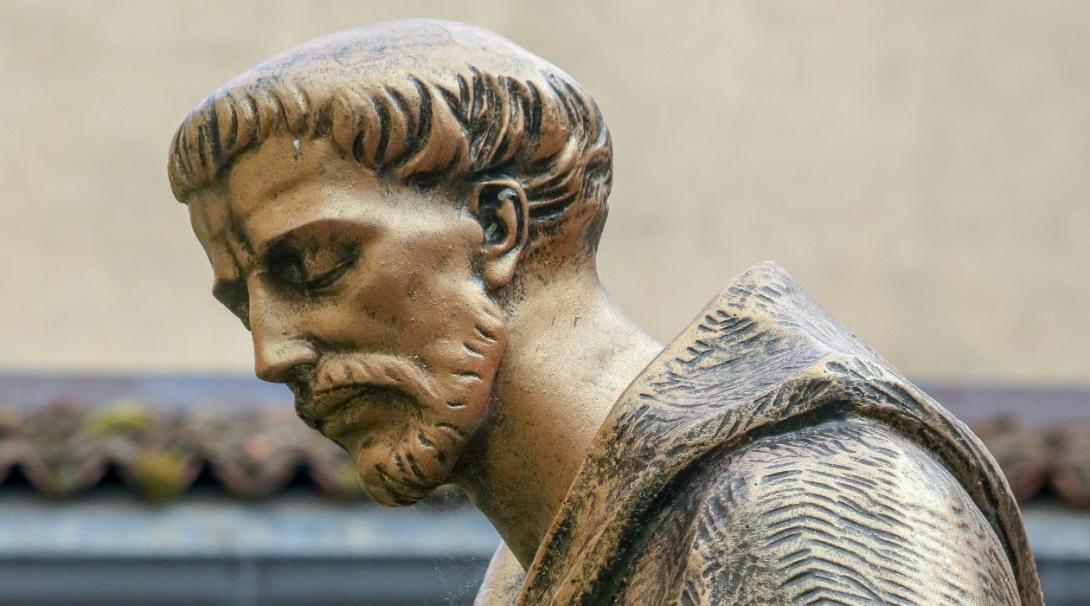
Photo by Mauro Fossati | Unsplash
Brotherhood and community were two of the environments of Francis’ love of God. He experienced the divine surrounded by others. We rarely talk about this with him. We turn more to his preaching to birds and salving lepers’ wounds—but his spiritual brothers were conduits to him of godly love more that all of the outdoors and its creatures. So for every birdbath Francis that exists I wish we had two sculptures of him with an arm around a friend. Because “Mother Earth” remains, even for someone with Francis’ ability to live in the moment, a bit of an abstraction. “Mother Earth” did not care for Francis—did not envelop him—in the way another person could and did.
He wrote a letter to all the friars in the early days, advising those who want to live in smaller groups to organize themselves around being “mothers” and “children,” taking turns caring for one another with a motherly love. There is no better way to feel God’s love than this, he said.
Francis advised his friars to live in groups of four: “Two of these brothers should be the mother and two, or at least one, the sons. The two who are mothers should follow the life of Martha, and the sons should follow the life of Mary.” Martha and Mary is a reference to the story in the New Testament Gospel of Luke where Martha busies herself with cooking and cleaning and caring for the home, when Jesus comes to visit, while Mary spends all her time with Jesus listening to his every word. Francis is saying that Mary could only do that because of Martha’s care for her, and isn’t that wonderful, and everyone should have such an opportunity.
There is no way to understand this motherly love as an experience of God without grasping what mystics have called the divine feminine, or the Divine Mother. The Jewish scriptures call her Sophia or Wisdom, the Mishnah calls her Shekinah, and the Hindu scriptures call her Shakti.
In the Wisdom of Solomon (a deuterocanonical book found in Catholic and Orthodox Christian bibles), Wisdom is the feminine personification of the Divine: “[I]n every generation she passes into holy souls and makes them friends of God and prophets, for God loves nothing so much as the person who lives with wisdom” (7:27).
Closer to home, and to our time, the great Black Gospel singer Marion Williams in her classic “Surely God Is Able,” pounds out the lyric, “He’s a mother for the motherless!” We see in Francis’ life how poignantly he felt fatherless in this world, and we can surmise, given the total absence of references to his mother, also, in his life and writings, that God was Francis’ Mother too.
Why a mother, specifically? Sister Joan Chittister put it very well thirty years ago in a book she wrote called Heart of Flesh:
It is precisely women’s experience of God that this world lacks. A world that does not nurture its weakest, does not know God the birthing mother. A world that does not preserve the planet, does not know God the creator. A world that does not honor the spirit of compassion, does not know God the spirit. God the lawgiver, God the judge, God the omnipotent being have consumed Western spirituality and, in the end, shriveled its heart.
Francis advised his friars to live in groups of four: ‘Two of these brothers should be the mother and two, or at least one, the sons. The two who are mothers should follow the life of Martha, and the sons should follow the life of Mary.
The Indian philosopher, yogi, and poet, Sri Aurobindo (d. 1950) taught often about the divine motherhood of God and how it is that feminine aspect of the divine that transforms people: “It is by the constant remembrance [of her] that the being is prepared for the full opening. By the opening of the heart the Mother’s presence begins to be felt and, by the opening to her Power above, the Force of the higher consciousness comes down into the body and works there to change the whole nature.” Also, “she throws a spell of the intoxicating sweetness of the Divine: to be close to her is a profound happiness and to feel her within the heart is to make existence a rapture and a marvel.”
This seems to explain the joy of Saint Francis, as well. He felt this sweetness. He was often accused of being intoxicated when he was in fact simply feeling bathed in motherly love. But he must have also known that not everyone is disposed, or given, such feelings and direct experiences. And so, he instructed those who wanted to follow in his path to help each other receive this love.
To be like mothers to each other.
Taking turns.
Consider this scripture: “[F]or wisdom, the fashioner of all things, taught me. There is in her a spirit that is intelligent, holy, unique, manifold, subtle, agile, clear…irresistible, beneficent, humane, steadfast…all-powerful, overseeing all, and penetrating through all spirits
that are intelligent, pure, and altogether subtle…. [S]he pervades and penetrates all things. For she is a breath of the power of God and a pure emanation of the glory of the Almighty…. [S]he is a reflection of eternal light, a spotless mirror of the working of God, and an image of his goodness. Although she is but one, she can do all things, and while remaining in herself, she renews all things; in every generation she passes into holy souls and makes them friends of God and prophets, for God loves nothing so much as the person who lives with wisdom. She is more beautiful than the sun and excels every constellation of the stars. Compared with the light she is found to be more radiant, for it is succeeded by the night, but against wisdom evil does not prevail. She reaches mightily from one end of the earth to the other, and she orders all things well.” (Wisdom of Solomon 7:22-8:1)
And try this: Ponder the qualities of a good mother. Take a few moments to make a list of them. Then consider, how might you be like a mother to someone in your life? And how might they be like a mother for you? Talk with that person—or those persons—about when you could begin taking turns.
This is an adapted excerpt from Jon M. Sweeney’s new book, Experiencing God: 36 Ways according to Saint Francis of Assisi, which was published on January 6, 2026. Used by permission.