Photo by courtesy of Father Justin Venn
Thanks for spending some time with us, Father Justin. Could you start by telling us where you grew up, a bit about your family, and where you live and work today?
I was born and raised in South Africa. My dad is also South African of English descent, and my mom is Dutch; she came to South Africa with her family when she was 18. I have one older sister too—they all live in Holland now.
Growing up, no one around me was religious me was religious, which I am actually thankful for because when I finally came to Orthodoxy, after a period of spiritual searching, I had a lot less 'religious baggage' to drop. My family are all pretty left-brained so I was definitely the odd one out, but I was never outright stopped in pursing my interests in the arts.
When I finished high school, I hit the road and travelled around Western Europe for a long time. I also made two trips to India. Finally, after around fifteen years of various adventures (during which time I discovered icons and Orthodoxy and converted) I settled back in South Africa, where I met my wife. We married, and had two boys, and I worked full time painting icons. Sadly, when we saw the way the country was going, like so many others, we made the hard decision to leave. I was a priest by then and wanted to get a transfer to another church in Europe, and the only place available happened to be a small Russian parish in northwest England. So that’s how we ended up here. The weather isn’t much to write home about but we are safe and happy. I work as second priest at the Russian parish I mentioned, plus rector of a parish In Belfast, and the rest of the time I paint icons in my studio at home.
How were you introduced to iconography? Did you study the art as well as the theology?
I was always painting or drawing something or other—cartoons, landscapes, portraits, whatever. But as I grew older, I felt frustrated as an artist because I felt like in order to be original one has to constantly innovate in one way or another. This involves a lot of exploration and confusion and I found it to be rather uninspiring.
Then, through my quest to find spiritual truth I came across Orthodoxy and the icon. I knew straight away this is what I had been looking for all along. It’s ironic because people often look at icons and think it’s just a matter of continuous copying of older models; that there is no space for creativity or originality, yet it’s really the opposite!
Painting within a centuries-long tradition with such deep theological roots, humbly learning from all those who have gone before you in that same tradition, and seeing how they constantly adapted and created new styles and icons in response to their environments and times, whilst still expressing the timeless truth of God himself, is totally liberating. Suddenly you find yourself free from your own very limited and egotistical attempts to create something new, and your originality can flow naturally because you work within parameters that actually serve a purpose bigger than yourself. Far from stifling, I find this to be so inspiring.
At that time, in the West, there was a real dearth of education both practically and theologically. There were no YouTube tutorials, or schools, or many experienced masters around who could take you on as an apprentice. The theology was contained in books with such varying interpretations and often wishy-washy claims that it was really difficult to get a clear theology down. That didn’t bother me much, though, because I think the icon speaks for itself in attesting to the Incarnation and holiness spread through the world by this monumental event.
Nowadays of course we have much more sound and traditional theology available in books and schools. The practical side is still lacking in the West however. When I decided to take it seriously and learn properly, I tried to go to Greece or Russia but it never panned out. I eventually found a professional iconographer in France whom I contacted to get the details of his former Russian teacher. He no longer had contact with that teacher but agreed to take me on as an apprentice, and so I leant the essential ABCs from him and then later moved into a monastery for about a year where the monks were painting icons. I learnt from them and then, through a long series of events, found myself back in South Africa where I just started painting full time, constantly striving to master the lessons I had been taught, which I'm still doing today.
Here icons are not just standalone objects of personal devotion but real persons in a real community of other persons. An Orthodox church should teleport you to the gates of paradise.
On your Instagram page, I’ve seen you speak of a “reawakening of the Orthodox history of the British isles” through iconography. What do you mean by that?
Well, the British Isles were in full communion with the entire Church until the schism of 1054 which split Christendom in two. From that time the Isles have gradually drifted further and further away from what we now call the Orthodox Church. As Orthodox Christians and iconographers now living in this time and place it seems natural that we should express this faith in a way that is local and relatable.
Orthodoxy has always done this: it grows roots wherever it goes and finally becomes fully native and unique—for that reason although the Romanian, Greek, Russian, and all the rest of the Churches share the same theology they nevertheless have a very different flavor, as it were. Language, liturgics, icons - all these things vary somewhat but they are all intelligible to their homelands. The problem in the British Isles, and the West in general, is that there has been such a long rupture in the iconographic tradition it would be very artificial to try to just go back to the local arts of the eleventh-century and starts reproducing that style. At the same time, one has to start somewhere. The problem is further compounded by the fact that there is such a variety of Orthodox influences we now have.
Tell us about a few of your favorite icons—ones that your hands have created, I mean.
Hmm, I’m not too sure what to say. I’m never fully satisfied with the results of my own work!
I can tell you however that I do enjoy is working in encaustic (hot and cold wax medium), which produces a very textured and chunky type of finish. It is so direct and physical and I feel like it creates icons that have real presence. The problem is it’s a complicated process to make and paint with so the icons in encaustic are quite expensive, and for that reason I don’t get many commissions for encaustic icons.
The other thing I enjoy very much is wall painting—that is, decorating the church building. I think this is really where we see icons acting in their full capacity, as it were. Here they manifest the divine presence and worship with us, reminding us that we are all one heavenly body. Here icons are not just standalone objects of personal devotion but real persons in a real community of other persons. An Orthodox church should teleport you to the gates of paradise.
Thanks for that… but can you also point to at least a couple of your icons, whether they are “favorites” or not? Perhaps I used the wrong word, there. Tell us about some of your icons that are for whatever reason among the most meaningful for you—and then we want to share images of these with our readers…
Ah, this is very difficult to do because so many of the icons I create are meaningful in some way or other. It would be easier for me to point out the icons I don’t like!
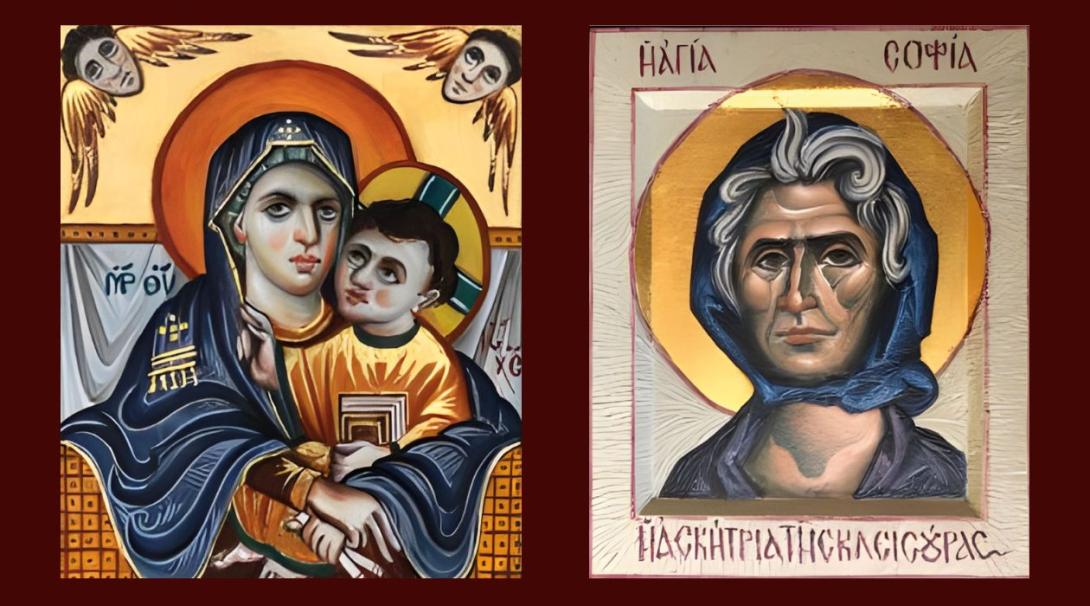
I think the first icon to mention is the Mother of God in the Ethiopian fashion—that’s the one with the two angel faces in the upper corners. It’s a small encaustic icon but it has so much presence and it reminds of Africa.
Secondly, I have an Image of the dome of the Romanian church I painted in South Africa. Although this was grueling work, every time I look at it, I am pleased and feel blessed to have brought this creation into a place where people can be inspired by it as they pray.
Thirdly, I have two icons of Western saints: Sigbhert and Samson of Dol. I am pleased with both of these icons but I include them especially because they are part of the revival of the Orthodox veneration of Western saints.
Fourth, I have an encaustic icon of St. Sophia of Kleissoura. This saint is dear to my heart because I encountered her early in my path to Orthodoxy, and I am particularly pleased with the icon because when the wax is polished the face literally scintillates in the candle light.
Great. Now, tell us about your new app, Icon Builder.
I have been teaching iconography for many years now and especially since Covid people have asked me to do online lessons. Initially I thought it can’t be done, but later, after done some online classes myself, I saw that it is indeed possible, although not ideal. However, it also dawned upon me that the way the world is going, and the necessity to make an income from this job, I had to get into the digital world.
I know many other iconographers who have made video tutorials and courses and sell them through Patreon, for example, but I wanted something more comprehensive and versatile and unique. And then it dawned upon me that an iconography app would fill those needs. I’m a very thorough teacher in person because if I didn’t start students from step 1, drawing, they would never be able to comfortably proceed to later steps. I see teachers jumping ahead to the most advanced stages (and indeed in weeklong workshops you don’t have any choice but to do that), but the students never manage to confidently progress further. This is because they don’t have the foundation to stand on. And this is what Icon Builder is designed to give—the essential building blocks of drawing in pencil, then black and white pencil on toned paper, and then monochromatic painting. If a student can master these steps, they will be able not only to create originally without copying all the time, but especially to move forward with confidence and little chance of serious error. There is also a group chat feature, specific videos on hands and feet and eyes, etcetera, loads of image resources, some prayers and theology, 3D models, the list goes on. We are planning on launching the app soon. It will be available on mobile devices on both Apple and Android.
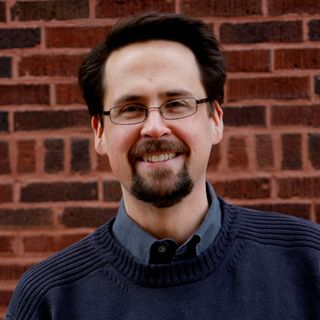
Father Justin Venn is originally from South Africa, now living in England. He’s in his young forties, married, with two boys ages nine and six. To learn more about his work, visit his website at www.studiosanctus.com, or follow him on Instagram @studiosanctus.