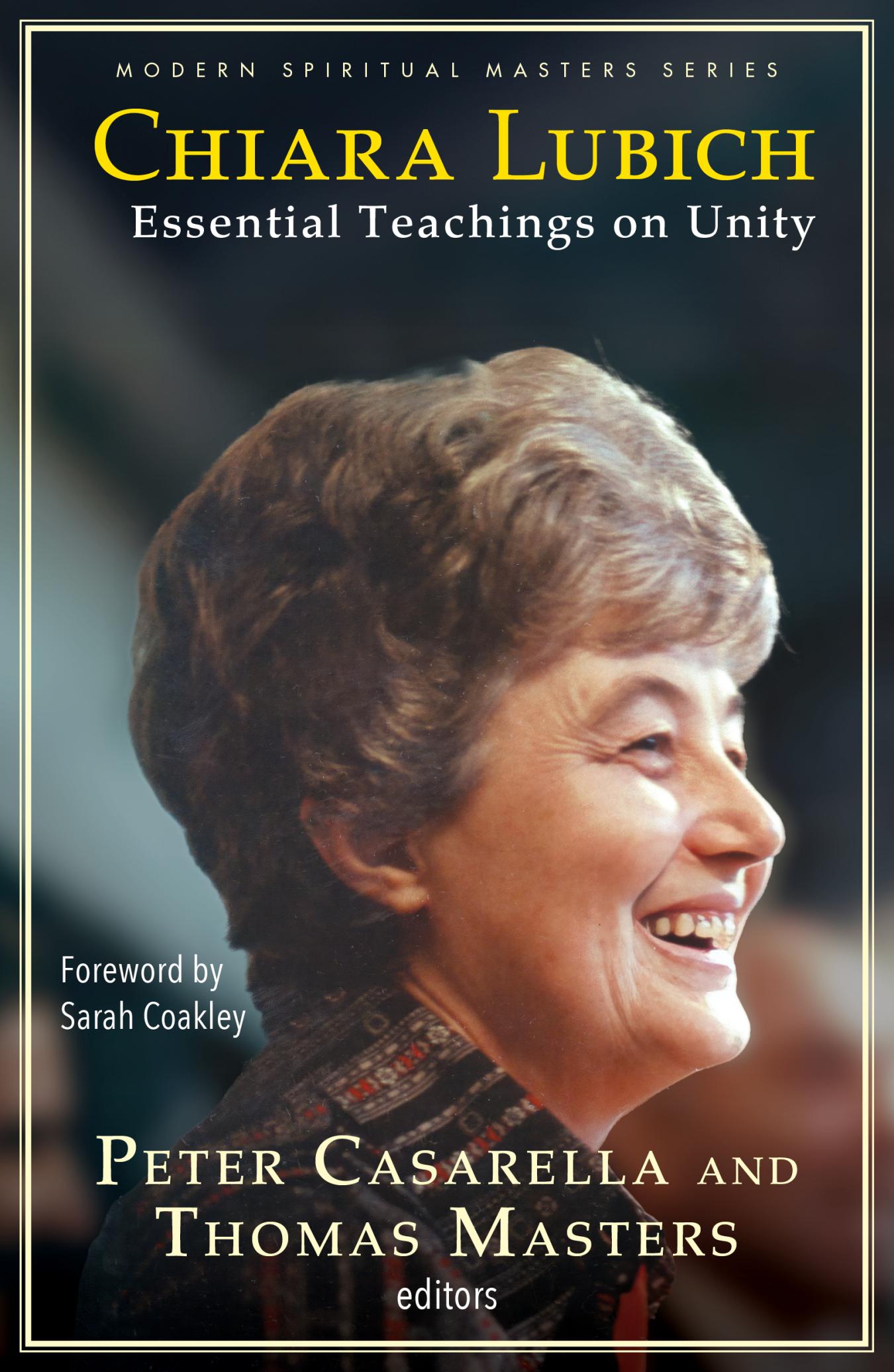
Chiara Lubich’s charism of unity— a prophetic response to polarization today
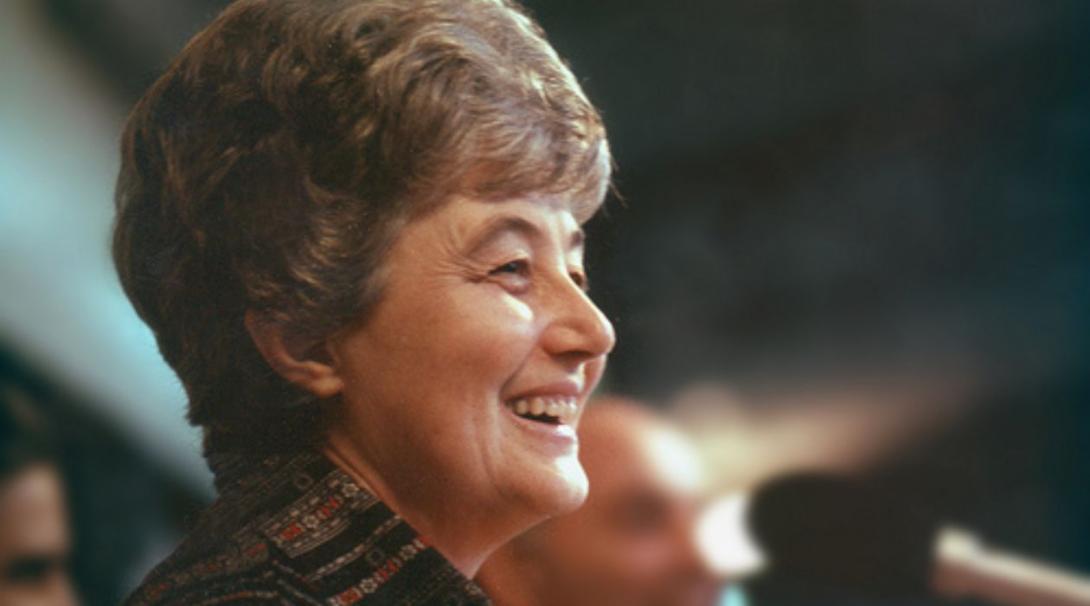
Chiara Lubich, Founder of the Focolare Movement
The following article is adapted from the introduction to a forthcoming book, Chiara Lubich: Essential Teachings on Unity, edited by Peter Casarella and Thomas Masters, to be published by Orbis Books next month.
On May 13, 1944, an Allied bombing raid destroyed much of Trent, including Chiara Lubich’s family’s home. She, as well as her original companions, young Catholic lay women, were traumatized by the wreckage that surrounded them—and yet their fidelity to the Gospel and to Jesus forsaken compelled them to remain where they were.
An intense spiritual commitment summoned Chiara and her cohort to live the unity that the Gospel called them to embody in war-torn Trent. The apostolic life which they shared through the unusual practice of reading the Bible and putting its words into practice became translated into a hitherto unknown form of life and new mode of engagement with the suffering and woundedness they confronted in their beloved city. Even as Trent was being bombed, Chiara and her companions put themselves at the service of those most in need, despite suspicion that they were collaborating with the Nazis because they loved even their enemies. Misperceptions of the aims of the original cohort abounded. Some called them Communists because they proclaimed an ideal of unity, and some called them Protestants because they were reading scripture without the guidance of a priest. They embarked together on a mission to seek unity even in those desperate spaces where, as in war-torn Trent, unity seemed impossible.
Chiara taught a spirituality of the abandoned Jesus oriented toward the personal and social struggles of daily life. Some questioned her relationship to the doctrine of the Church, but neither she nor the movement she started was ever found deficient. Her spirituality did not intend a watering down of Church doctrine. Her charism, which emerged in the 1940s, offers a new opportunity for renewal within and outside the Church. Although it predates Vatican II by almost thirty years, it follows the pattern of renewal established at the council. It is thus a spirituality that allows a new Pentecost. The Holy Spirit guided Chiara and her earliest companions and reinforced their experience of the Word of God. The Spirit brings them together by aligning their hearts to one another and inviting them to experience Christ in the Eucharist. Word and Spirit complement one another, joining together Chiara and her followers to serve as disciples of Jesus Christ.
Chiara’s charism of unity was passed on to a new generation, even during her lifetime, for she never conceived that charism to be a possession that she could retain. She was given the gift to teach others to share God’s unique gift of love.
Chiara’s entire itinerary is dedicated to forging a spirituality that speaks to the now of God.
Today, this charism of unity has a special meaning and importance in our age that is so dominated by polarization. The Instrumentum laboris for the Second Session of the Synod on Synodality has prophetically identified polarization and the violence it begets as real challenges in the Church today and in contemporary life. Chiara Lubich knew that there can be no “Kumbaya moment” that will make divisions disappear all at once. Instead, Lubich and Popes Francis and Leo XIV urge us to enter with the serenity of Jesus Christ directly into this rancor in order to discern a patient path to dispelling misconceptions and false antinomies.
Her charism of unity beckons us to find a new starting point for addressing polarization. The way families, communities, regions, and countries are being infected daily with the virus of polarization demonstrates the timeliness of Chiara’s artisanship of fraternity and peace.
In each place the movement that Chiara initiated draws upon the genius of that particular culture. Given the consumerist and individualistic lifestyles that dominate contemporary Western cultures in Europe and North America, the communitarian elements in this spirituality might seem highly problematic. However, an inculturated spirituality of communion fosters building diverse communities comprised of both religious and civic groups at local levels, thus countermanding effectively the North American tendency “to bowl alone,” as Robert Putnam put it in his 2000 book with that title.
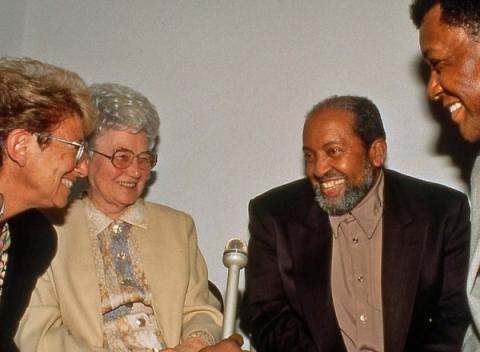
The charism lived by Focolare members in the U.S. has also served as a witness to healing the sin of racism. After Chiara Lubich’s unprecedented visit to Harlem in 1997, she made a historic and mutually binding pact with Imam W.D. Mohammed and those who have followed his path. Subsequently, the ongoing efforts to foster Muslim-Christian dialogue represent noteworthy healing of social and religious divisions. Finally, the witness of Focolare in the United States to Jewish-Christian dialogue has involved key clerics and bishops, thus offering a model and witness for the whole Church.
We are particularly struck by how Chiara’s spiritual way can serve young people as well as the educators, teachers, and pastoral workers who accompany them. Pope Francis described young people like this: “You are the now of God, and he wants you to bear fruit. For ‘it is in giving that we receive.’ The best way to prepare a bright future is to experience the present as best we can, with commitment and generosity.” Chiara’s entire itinerary is dedicated to forging a spirituality that speaks to the now of God. She crafted a path that always seeks to discern the signs of the times read in the light of the Gospel, even when these glints of illumination are found at the far edge of what separates the present from the future.
She drew upon the past for wisdom but always looked to the future to discover new ways to apply that wisdom to the present and emerging needs of the Church and the world. She teaches us to look at the important task of using a new lens to train as leaders those who are disempowered and at the margins. Like Catherine of Siena and Dorothy Day, she was a creative innovator of Jesus’ own start-up.
The movement of the Spirit that Chiara Lubich started while surveying the rubble of her beloved Trent in World War II is hardly finished. Its reverberating presence is felt throughout the globe among believers and non-believers. The work of Mary that she initiated almost a century ago has just begun.
If you enjoyed this article, you might like...