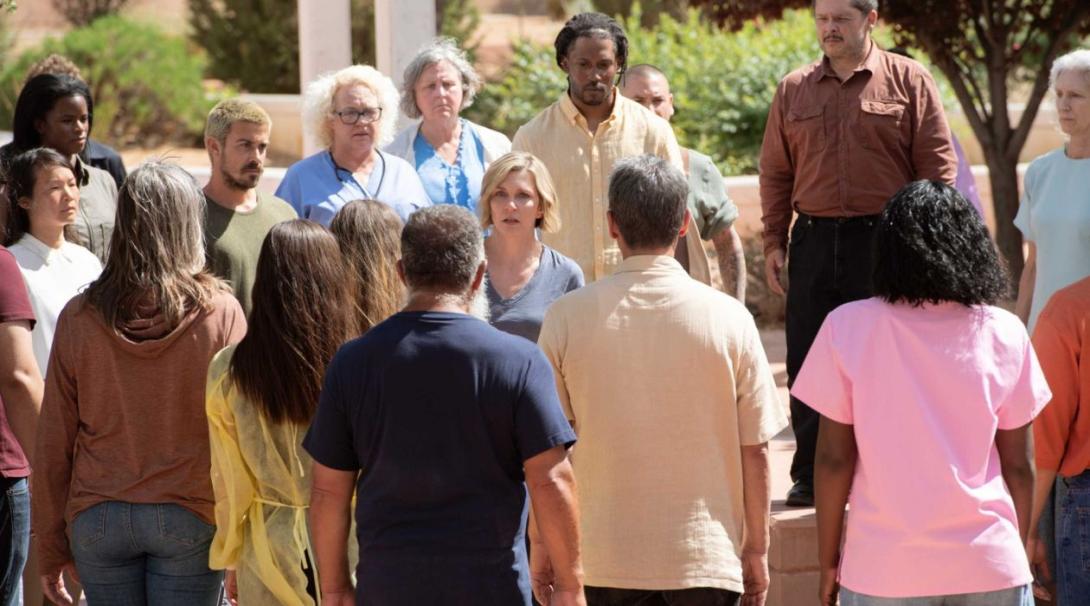
Frame from the Apple TV+ series Pluribus.
I’ll bet that anyone who is in any way committed to working for a more united world and healing divisions in our society will find the Apple TV show Pluribus thought-provoking, to say the least.
I’m often resistant to starting a new series, but I decided to give this one a try after learning that its creator is Vince Gilligan, best known for the critically acclaimed Breaking Bad. (That, and the fact that my 25-year-old brother recommended it—and he usually has good taste.)
The premise of the show seems fairly conventional at first. An extraterrestrial virus infects almost all human beings on Earth. What is decidedly unconventional, however, is the effect of the virus. There is no mortal illness, no zombies, no vampires. Instead, those who are infected become perfectly connected to one another telepathically and emotionally, to the point of thinking and acting as part of a single “global consciousness.”
Once absorbed into this collective mind, people become serene, non-violent, deeply compassionate, and—needless to say—perfectly collaborative. In many ways, it seems like a concrete realization of John Lennon’s “Imagine”: “no countries, no possessions, nothing to kill or die for… and the world would live as one.” At first glance, it doesn’t sound so bad.
And yet, as we follow Carol, the protagonist of the show and one of the very few people on Earth who is immune to the virus, a sense of unease slowly emerges. By joining this collective consciousness, people lose their individual conscience, which is melted into an indistinct oneness. They are no longer able to say “I”; they can only say “we.”
We live in a society deeply plagued by toxic polarization. Pluribus forces us to imagine a world with no divisions at all.
As a result, there is no real difference between one person and another. Everyone shares the same information, the same feelings, the same way of reasoning. It is an extremely efficient system, and yet one that no longer feels fully human.
Watching the show with a Christian eye, one inevitably begins to ask deeper questions: What is unity, really? And what kind of unity does Jesus ask for? Jesus prayed “that they may all be one, as you, Father, are in me and I in you” (John 17:21). This question leads us directly to the heart of Christian faith: the mystery of the Trinity. We believe in a God who is a communion of persons, where union and distinction coexist perfectly.
We live in a society deeply plagued by toxic polarization. Pluribus forces us to imagine a world with no divisions at all. And paradoxically, the result seems just as dehumanizing as the fractured reality we are living in today. Even positive behaviors like compassion, collaboration, and non-violence lose their human dimension when they are no longer rooted in personal freedom and free choice.
The title of the show is a clear reference to the famous Latin motto, Ex pluribus unum, which means “Out of many, one.” But anyone working for a more peaceful society—whether from a religious or a civic standpoint—should never forget that unum cannot mean a uniformity that destroys the richness of our differences.
This is even more true for people who feel called to live the spirituality of unity of the Focolare. A few years ago, we published an important book entitled What Is Unity? which dives into the interpretation of unity according to the mystical experience of Chiara Lubich known as Paradise ‘49. In one of the chapters, we read:
Unity as Chiara experienced it in Paradise ’49 does not flatten the specific characteristics of different people nor make them uniform. Rather, it purifies them, opens them out to others, and brings them to a fuller realization. Unity is a continual uniting and distinguishing, and if lived in the right way, it helps avoid self-absorption and enables each person to be increasingly an expression of the multiform richness of unity.
Watching Pluribus reminded me that unity cannot be engineered or imposed. True unity is always a risk, because it passes through personal freedom and the creative tension of relationship. As a consequence, like Pope Francis reminded us, the shape of unity is much more like a polyhedron— a solid with sharp edges where each face occupies a different position in relation to the center—than a sphere, in which every point is equidistant, and all parts are identical. It is precisely this kind of unity that Chiara Lubich often invited her followers to live when she spoke of “Trinitarian relationships”: bringing to earth the very life of God Himself, a unity that does not erase differences, but makes them an expression of communion.