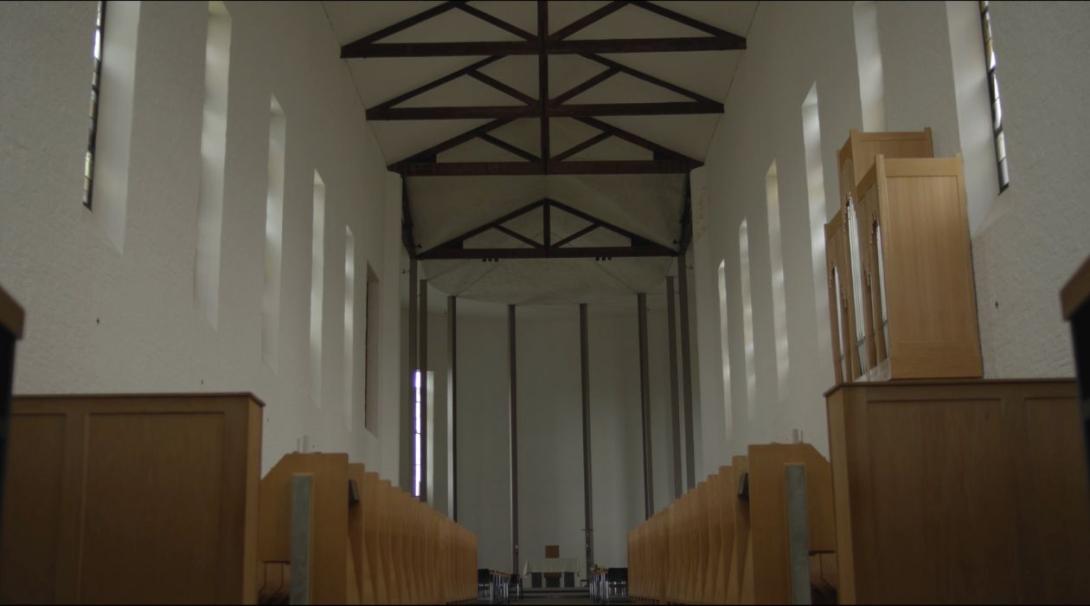
A still from Quest for Beauty documentary, of the inside of the Abbey of Gethsemani church
“My whole personal life has been a search for beauty,” we hear William Schickel say in his own voice at the start of this 45-minute documentary directed by David Whitaker, assistant professor of Media Communication at Asbury University, and produced by Creo Arts, a national nonprofit ministry “devoted to awakening the world to the beauty of the Christian story through the arts,” whose executive director is Dr. Winfield Bevins, artist-in-residence at Asbury Theological Seminary.
Schickel (1919-2009) was a twentieth-century Catholic artist with a career spanning more than six decades. He produced a large body of mostly commissioned work in painting, sculpture, stained glass, and architectural design—always infusing contemporary art techniques and media, often in religious settings. “Bill Schickel essentially integrated both ancient theological traditions and modern artistic language,” says one expert here.
Interviews with experts are interspersed throughout the film, including Schickel’s son, Joe Schickel, art historian Dr. Linda Stratford, and Schickel biographer Gregory Wolfe. We see and hear the influences on the artist’s early life, his education, and artistic tutelages.
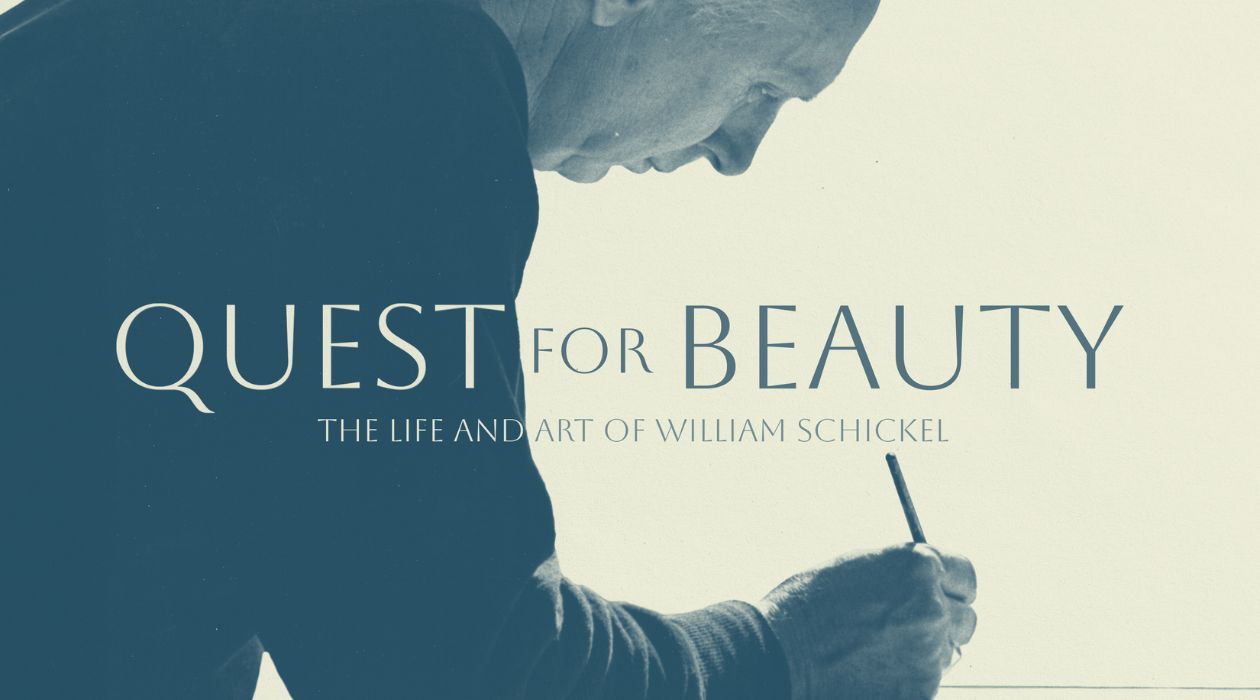
Quest for Beauty documentary
Bill Schickel’s mother died when he was only three years old. The family then moved to Ithaca, New York, where his father struggled to find consistent work. It was an elementary school teacher who first encouraged Schickel’s interest in art.
When Schickel’s older brother went to University of Notre Dame for college, it led to Bill following him there, and his art interest and experiences really began to build. After college, the most important influence on Bill’s life came from his art mentor, stained-glass artist Emil Frei, who also helped Bill to meet the woman who would become his wife, Frei’s daughter, Mary.
After Schickel and Mary wed, they move to Loveland, Ohio, near the headquarters of the Grail Movement, of which Mary was a passionate member. There in Loveland, Schickel designs the Grailville Oratory out of an old barn, has his studio, and also in Loveland he and Mary raise their eleven children. The William Schickel Gallery is still there in Loveland.
Schickel is perhaps most known for his renovation of the Abbey of Gethsemani in Kentucky, where he worked in the 1960s sometimes alongside the famous Catholic monk and writer, Thomas Merton. In his bestselling autobiography, The Seven Storey Mountain, Merton had spoken of the impact that wandering around the cathedrals of Europe had upon his own conversion to Christianity from atheism.
The documentary experts reflect on the spareness of line and shape in all of Schickel’s work, and the lack or ornamentation as reflective of the simple, original beauty of nature itself.
The renovation at Gethsemani took place during and immediately after the Second Vatican Council, when Schickel’s more spare, modernist approach was seen (by some) as an ecclesiastically-approved change from what had previously been an extravagant form of Gothic Revival vaulting in that church ceiling. With help from interview subject Brother Paul Quenon, OCSO, a monk who was there at Gethsemani in the ‘60s and is still there today, Quest for Beauty chronicles the process, and the personalities carefully, during the complete renovation. Merton loved the simplicity of Schickel’s work. And Merton compared Schickel’s modern approach to what he appreciated at the nearby Shaker village, as Schickel sought to remove all of the decoration that had little meaning in what was previously a faux Gothic style. The result was cleaner lines, and a brighter, lighter, and simpler approach, as an invitation to contemplation.
Anyone who visits the Abbey today sits among Schickel’s artistic vision, which the monks there will tell you is not only the modern work of William Schickel, but refreshingly faithful to the original Cistercian ideals from the Middle Ages.
The documentary experts reflect on the spareness of line and shape in all of Schickel’s work, and the lack or ornamentation as reflective of the simple, original beauty of nature itself. In fact, ornamentation in religious art is often understood today, given the influence of artists like Schickel, as an interruption of God’s beauty, rather than an enhancement of it.
William Schickel died in 2009 in Loveland. His works can be found in numerous private collections and museums, including the Vatican Museum. This documentary explores his life’s search for God’s beauty, and the challenges he faced in doing so, as well as his vision for the Church universal and heart for unity in the Body of Christ. We recommend it.
Quest for Beauty is currently available for streaming on Amazon Prime (for a $2.99 rental), and is being shown in locations across the United States, including, currently at the Cincinnati Art Museum. To watch a trailer, click here. Link to the William Schickel Gallery